
MINISO AI DESIGN CONTROVERSY | WHEN AI PUT POP MART ON YOYO
Generative AI has made image production dramatically faster. A brand can now create a promotional visual in minutes rather than waiting through a traditional production cycle. Speed is useful, but speed also changes where mistakes can enter the process.
MINISO recently became a clear example. In August 2026, consumers noticed that a promotional image for the company’s proprietary character YOYO contained the words POP MART, the name of a major competitor in China’s collectible toy market.
The issue was not an incorrect finger or an awkward background detail. It placed another brand’s name directly inside official promotional material for one of MINISO’s most important proprietary IPs.
That makes the case useful for any company experimenting with AI assisted design. The central question is not whether AI can generate attractive images. The question is whether a brand has enough human judgment, brand knowledge and quality control around the tool to prevent an efficient workflow from becoming a reputational problem.
QUICK ANSWER
On August 13, 2026, consumers reported seeing a MINISO YOYO promotional visual in which the figure carried the words POP MART. On August 17, MINISO told Beijing Daily that the image was a visual reference created during campaign production rather than a photograph of a product for sale. The company said inaccurate elements appeared during generation and review, that the material had been removed, and that it would strengthen review of AI assisted design content.
The incident mattered because YOYO is not a minor campaign asset. MINISO launched the proprietary character in 2025 and has been scaling it internationally. By August 2026, the company said YOYO had reached 53 countries and regions, while China sales in June alone exceeded US$14 million.
For brands, the lesson is straightforward. AI can accelerate execution, but it does not replace brand governance. The faster content can be generated, the more important final human review becomes.
WHAT HAPPENED TO MINISO YOYO
The controversy began after consumers shared a promotional image distributed through MINISO related channels. The image featured YOYO, but the figure or base included the words POP MART.
Because POP MART is a recognizable competitor in the same broader collectible and character merchandise category, the visual created immediate confusion over whether the two companies were collaborating.
MINISO later said the material was only a visual reference used during campaign production and was not an image of the final retail product. The company stated that inaccurate elements had appeared during the generation and review process, that the content had been taken down, and that a review and correction process had begun.
Importantly, the official response did not say that there had been no human review. It said the generation and review process produced an inaccurate result. That distinction matters because the failure was not only an AI output problem. It was also a workflow problem.

MINISO YOYO AI design controversy showing POP MART wording in a promotional visual
WHY THIS ERROR WAS BIGGER THAN A TYPO
If the same mistake had appeared in a low value internal mockup, the consequences would have been limited. The context made this incident more sensitive.
YOYO is part of MINISO’s effort to build proprietary IP rather than relying only on licensed characters. MINISO says the character has expanded to 53 countries and regions, and that China sales in June 2026 exceeded US$14 million.
That means every official YOYO visual is doing more than selling one product. It is helping establish ownership, originality and recognition around a character that MINISO wants consumers to associate with the company itself.
When a competitor’s name appears inside that visual, the error can create questions that are larger than the image. Consumers may wonder whether the work was based on another brand, whether the two companies are collaborating, or whether the brand itself has strong enough control over its own visual assets.
A branding mistake is therefore not measured only by how visible the typo is. It is measured by which brand asset the mistake touches.
AI AVERSION AND THE TRUST PROBLEM
The reaction also connects to a wider question about how people respond when they believe content was created by AI.
Raptive commissioned a 2025 study of 3,000 US adults and found that content people believed was AI generated was rated 48 percent less trustworthy and 57 percent less authentic. Advertising shown beside content perceived as AI made also saw a 14 percent decline in purchase consideration and willingness to pay a premium.
This research was about digital content and adjacent advertising, not about MINISO or product design specifically. It should not be treated as proof that every AI generated brand image causes the same effect. It does, however, illustrate a broader reputational risk. Once people suspect that a brand is using automated content carelessly, distrust can spread beyond the single asset that contained the mistake.
A related idea in behavioral research is algorithm aversion. Dietvorst, Simmons and Massey found that people can lose confidence in algorithms quickly after observing them make errors, even when the algorithm performs well overall.
For brands, that creates an asymmetry. One obvious AI error can attract much more attention than dozens of ordinary successful outputs.
THE REAL FAILURE WAS NOT AI, IT WAS GOVERNANCE
It is tempting to describe this case as evidence that AI should not be used for design. That conclusion is too simple.
AI can be useful for concept exploration, visual references, background generation, versioning and rapid experimentation. The problem appears when a company treats generated output as finished communication rather than as material that still requires brand judgment.
A mature AI workflow needs clear brand references, restricted logo use, approved product assets, human review and a final publishing checkpoint. The more important the asset, the stricter the review should be.
In this case, the words POP MART were not a subtle visual defect. They were a competitor name appearing in official communication. A basic brand review should be designed to catch exactly that type of error.
The lesson is not that humans never make mistakes. They do. The lesson is that AI increases output speed and volume, so companies must deliberately increase the strength of their control system at the same time.
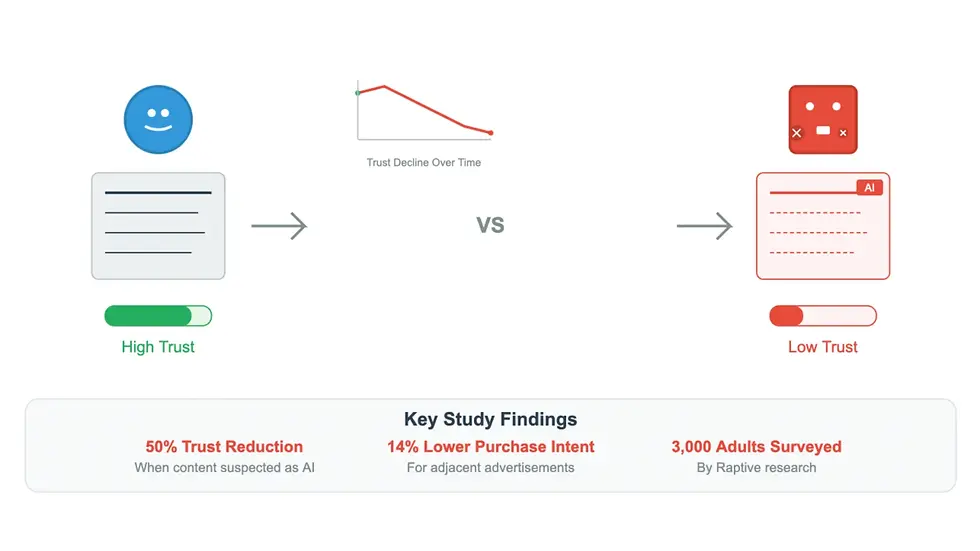
consumer trust data showing lower trust and purchase consideration for content perceived as AI generated.
AI CAN GENERATE IMAGES, BUT IT DOES NOT OWN THE BRAND CONTEXT
Generative models do not automatically understand which details are strategically important to a company unless that context is supplied and enforced in the workflow.
A system may generate a visually plausible toy base, package label or logo like mark because those patterns appear statistically compatible with the image. That does not mean it understands the commercial relationship between MINISO, YOYO and POP MART in the way a brand manager or designer should.
This is why brand design cannot be reduced to image generation. Professional design also involves selection, exclusion, hierarchy, meaning, intellectual property awareness and responsibility for the final message.
The value of the human designer is therefore shifting. The important skill is no longer only producing pixels. It is knowing what the brand should say, what it must never say, and which visual decisions can damage years of accumulated recognition.
EUTOPIA INSIGHT | THE FASTER THE TOOL, THE STRONGER THE REVIEW
AI is not the opposite of professional design. Used well, it can become part of a professional design system.
The risk begins when speed is mistaken for completion. A generated visual can look polished while still containing the wrong logo, the wrong product detail, the wrong cultural cue or an unintended reference to a competitor.
Brands should therefore treat AI output like an accelerated draft, not an automatic final file.
The strongest workflow combines machine speed with human accountability. AI can produce options. People still need to decide what represents the brand.
WATCH THE FULL CASE STUDY
Watch the Eutopia YouTube episode for the complete visual breakdown of the MINISO YOYO case, the promotional image and the wider discussion about AI in creative work.
FAQ
Q: What happened in the MINISO YOYO AI design controversy?
A: A YOYO promotional image distributed in August 2026 contained the words POP MART. MINISO later said the visual was a campaign reference rather than a final product image and acknowledged that inaccurate elements appeared during generation and review.
Q: Did MINISO say the image was created with AI?
A: MINISO said it would strengthen review of AI assisted design content. Its response linked the incident to the generation and review of AI assisted materials, while describing the image as a visual reference rather than a retail product photograph.
Q: Is YOYO a MINISO proprietary IP?
A: Yes. MINISO describes YOYO as a proprietary IP. The company says the character has expanded to 53 countries and regions and generated more than US$14 million in China sales in June 2026 alone.
Q: What is AI aversion?
A: The term is commonly used for situations in which people become reluctant to rely on algorithmic systems, especially after seeing them make mistakes. Research also suggests that content perceived as AI generated can be judged as less trustworthy or authentic.
Q: Does this mean brands should stop using AI for design?
A: No. The stronger lesson is that AI generated material needs brand specific controls and human review. AI can speed up production, but responsibility for the final communication remains with the organization publishing it.


Comments